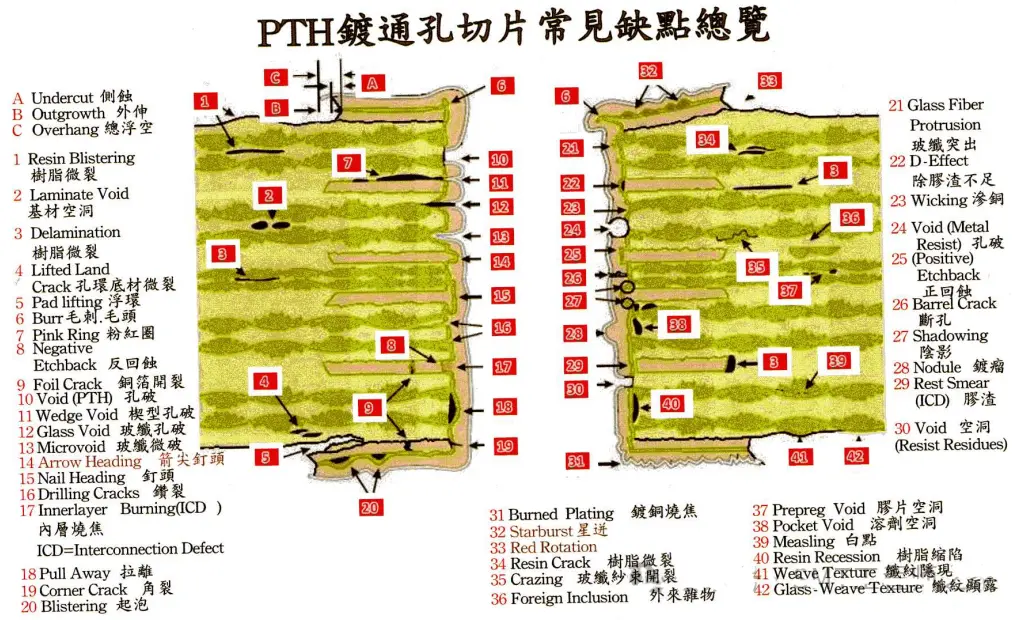
The following lists various defects of PTH plated through - hole cross - sections, covering 42 types of defects from resin blistering, laminate void to glass fiber protrusion, foreign inclusion, etc. Meanwhile, process issues such as undercut, outgrowth, and overhang are marked. It provides an intuitive and comprehensive reference for the PCB (Printed Circuit Board) industry to analyze the quality defects of PTH plated through - holes and optimize the production process.
- Resin Blistering
- Laminate Void
- Delamination
- Lifted Land
- Pad lifting
- Burr
- Pink Ring
- Etchback
- Foil Crack
- Void(PTH)
- Wedge Void
- Glass Void
- MICrovoid
- Arrow Heading
- Nail Heading
- Drilling Cracks
- Innerlayer Burning(ICD ) (ICD=Interconnection Defect)
- Pull Away
- Corner Crack
- Blistering
- Glass Fiber Protrusion
- D - Effect
- Wicking
- Void (Metal Resist)
- Etchback (Positive)
- Barrel Crack
- Shadowing
- Nodule
- Rest Smear (ICD)
- Void (Resist Residues)
- Burned Plating
- Starburst
- Red Resin
- Resin Crack
- Crazing
- Foreign Inclusion
- Prepreg Void
- Pocket Void
- Measling
- Resin Recession
- Weave Texture
- Glass - Weave - Texture
- A Undercut
- B Outgrowth
- C Overhang
In the printed circuit board (PCB) manufacturing process, PTH (Plated Through Hole) is a core link for realizing the interconnection of multi - layer circuits, and its quality directly affects the electrical pe
RFormance and reliability of the circuit board. The diagram "Overview of Common Defects in PTH Plated Through - Hole Cross - Sections" systematically presents various defects in this link, providing an intuitive guide for industry analysis and process optimization.
In terms of defect types, this diagram covers 42 typical problems, which can be roughly divided into material defects (such as resin blistering, laminate void, and glass yarn bundle cracking), process defects (such as undercut, outgrowth, and overhang), plating and etching defects (such as burned plating, etchback, and positive etchback), and hole wall defects (such as void, barrel crack, and rest smear). For example, "resin blistering" is caused by the deformation and cracking of resin after being heated or stressed, and "glass fiber protrusion" is the manifestation that glass fiber is not completely covered in the manufacturing process; process problems such as undercut and outgrowth reflect the precision deviation in the drilling and etching links.
The existence of these defects will have multi - dimensional impacts on PCBs: in terms of electrical performance, void and barrel crack can lead to open circuits, and wicking may cause short circuits; in terms of mechanical performance, delamination and foil crack will weaken the strength of the hole wall and reduce the bending resistance of the circuit board; in terms of long - term reliability, defects such as foreign inclusion and nodule are likely to become the starting point of corrosion and accelerate the aging of the circuit board.
For the PCB industry, the value of this defect overview is self - evident. It provides a "defect dictionary" for quality inspectors, facilitating quick problem identification; it provides a target for process engineers to optimize the manufacturing process —— for resin blistering, material selection and curing process can be optimized, and for undercut, etching parameters and mask precision can be adjusted; it also helps the industry establish a standardized defect analysis system, promoting the quality upgrade of the PTH process and even the entire PCB manufacturing process.

 PCB
PCB FPC
FPC Rigid-Flex
 FR-4
FR-4 HDI PCB
 Rogers High-Frequency Board
 PTFE Teflon High-Frequency Board
 Aluminum
 Copper Core
 PCB Assembly
 LED light PCBA
 Memory PCBA
 Power Supply PCBA
 New Energey PCBA
 Communication PCBA
 Industrial Control PCBA
 Medical Equipment PCBA
 Testing Service
 PCBA Testing Service
 Certification Application
 RoHS Certification Application
 REACH Certification Application
 CE Certification Application
 FCC Certification Application
 CQC Certification Application
 UL Certification Application
 Transformers, Inductors
 High Frequency Transformers
 Low Frequency Transformers
 High Power Transformers
 Conversion Transformers
 Sealed Transformers
 Ring Transformers
 Inductors
 Wires,Cables Customized
 Network Cables
 Power Cords
 Antenna Cables
 Coaxial Cables
 Net Position Indicator
 Solar AIS net position indicator
 Capacitors
 Connectors
 Diodes
 Embedded Processors & Controllers
 Digital Signal Processors (DSP/DSC)
 Microcontrollers (MCU/MPU/SOC)
 Programmable Logic Device(CPLD/FPGA)
 Communication Modules/IoT
 Resistors
 Through Hole Resistors
 Resistor Networks, Arrays
 Potentiometers,Variable Resistors
 Aluminum Case,Porcelain Tube Resistance
 Current Sense Resistors,Shunt Resistors
 Switches
 Transistors
 Power Modules
 Isolated Power Modules
 AC-DC Power Modules
 DC-AC Module(Inverter)
 RF and Wireless