
 PCB
PCB FPC
FPC Rigid-Flex
 FR-4
FR-4 HDI PCB
 Rogers High-Frequency Board
 PTFE Teflon High-Frequency Board
 Aluminum
 Copper Core
 PCB Assembly
 LED light PCBA
 Memory PCBA
 Power Supply PCBA
 New Energey PCBA
 Communication PCBA
 Industrial Control PCBA
 Medical Equipment PCBA
 Testing Service
 PCBA Testing Service
 Certification Application
 RoHS Certification Application
 REACH Certification Application
 CE Certification Application
 FCC Certification Application
 CQC Certification Application
 UL Certification Application
 Transformers, Inductors
 High Frequency Transformers
 Low Frequency Transformers
 High Power Transformers
 Conversion Transformers
 Sealed Transformers
 Ring Transformers
 Inductors
 Wires,Cables Customized
 Network Cables
 Power Cords
 Antenna Cables
 Coaxial Cables
 Net Position Indicator
 Solar AIS net position indicator
 Capacitors
 Connectors
 Diodes
 Embedded Processors & Controllers
 Digital Signal Processors (DSP/DSC)
 Microcontrollers (MCU/MPU/SOC)
 Programmable Logic Device(CPLD/FPGA)
 Communication Modules/IoT
 Resistors
 Through Hole Resistors
 Resistor Networks, Arrays
 Potentiometers,Variable Resistors
 Aluminum Case,Porcelain Tube Resistance
 Current Sense Resistors,Shunt Resistors
 Switches
 Transistors
 Power Modules
 Isolated Power Modules
 AC-DC Power Modules
 DC-AC Module(Inverter)
 RF and Wireless
Designing Solder Mask Opening Compensation to Offset Exposure-Development Dimensional Deviation
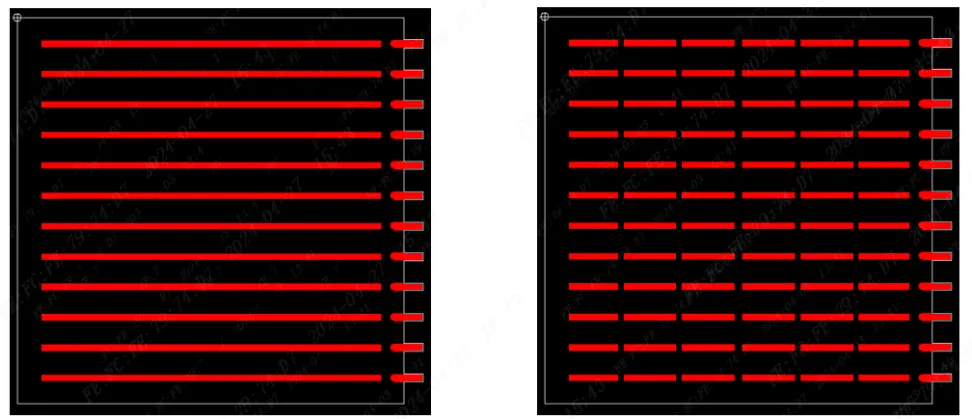
1. Sources of Dimensional Deviation
-
Exposure tool accuracy: OptICal distortion (±5μm) and alignment errors.
-
Photoresist properties: Shrinkage (0.1–0.3%) and swelling during development.
-
Development process: Temperature (±1°C) and pressure (±0.1 bar) variations.
-
Solder mask flow: Thickness non-uniformity (CV>5%) causing edge retraction (±3–8μm).
2. Compensation Design Methodology
2.1 Experimental Modeling
-
DOE (Design of Experiments): Analyze key factors (line width, spacing, ink thickness).
Example:Design (μm) Exposure (mJ/cm²) Develop (s) Actual (μm) Deviation (μm) 100 120 60 103 +3 100 150 60 98 -2 -
Regression analysis: Derive compensation formula, e.g.,
�comp=�design−(0.15×InkThickness+0.05×DevelopTime).
2.2 Zone-Specific Compensation
-
Center-edge compensation: Add 2–3μm to edge openings due to thermal gradient.
-
Dense area compensation: Use nonlinear models (e.g., quadratic) for pitches <100μm.
2.3 Dynamic Adjustment
-
Real-time feedback: AOI + PID control for adaptive compensation.
-
Compensation mapping: Historical data-driven per-pixel adjustment.
3. Key Parameters & Validation
-
Compensation range: ±5μm (based on Cpk≥1.33).
-
Validation steps:
-
Test patterns: Include stepwise line widths (50–200μm) and grids.
-
Process: Standard LDI exposure (150mJ/cm²) + Na₂CO₃ development (1%).
-
Metrology: Laser confocal microscopy (±0.1μm) or 3D-AOI.
-
Model calibration: Iterate until deviation <±2μm (6σ).
-
4. Process Control
-
Photoresist selection: Low-shrinkage materials (e.g., TMMF S2030, <0.1%).
-
Development optimization:
-
Temperature: 30±0.5°C
-
Spray angle: 30°, coverage ≥120%
-
-
Curing profile: Stepwise heating (80°C→150°C→180°C) to minimize stress.
5. Case Studies & Results
-
Case 1: High-frequency PCB (75μm line)
-
Compensation: Design=73μm (-2μm)
-
Result: 74.8±0.5μm, Cpk=2.0
-
-
Case 2: HDI blind via (50μm opening)
-
Dynamic compensation: Adjusted by real-time conductivity (±1μm)
-
Result: Yield increased from 92% to 98%
-