
 PCB
PCB FPC
FPC Rigid-Flex
 FR-4
FR-4 HDI PCB
 Rogers High-Frequency Board
 PTFE Teflon High-Frequency Board
 Aluminum
 Copper Core
 PCB Assembly
 LED light PCBA
 Memory PCBA
 Power Supply PCBA
 New Energey PCBA
 Communication PCBA
 Industrial Control PCBA
 Medical Equipment PCBA
 Testing Service
 PCBA Testing Service
 Certification Application
 RoHS Certification Application
 REACH Certification Application
 CE Certification Application
 FCC Certification Application
 CQC Certification Application
 UL Certification Application
 Transformers, Inductors
 High Frequency Transformers
 Low Frequency Transformers
 High Power Transformers
 Conversion Transformers
 Sealed Transformers
 Ring Transformers
 Inductors
 Wires,Cables Customized
 Network Cables
 Power Cords
 Antenna Cables
 Coaxial Cables
 Net Position Indicator
 Solar AIS net position indicator
 Capacitors
 Connectors
 Diodes
 Embedded Processors & Controllers
 Digital Signal Processors (DSP/DSC)
 Microcontrollers (MCU/MPU/SOC)
 Programmable Logic Device(CPLD/FPGA)
 Communication Modules/IoT
 Resistors
 Through Hole Resistors
 Resistor Networks, Arrays
 Potentiometers,Variable Resistors
 Aluminum Case,Porcelain Tube Resistance
 Current Sense Resistors,Shunt Resistors
 Switches
 Transistors
 Power Modules
 Isolated Power Modules
 AC-DC Power Modules
 DC-AC Module(Inverter)
 RF and Wireless
How to Design the Etching Solution Spray Angle to Ensure Consistent Side Etching Amount of Two-Layer Circuits When Etching Double-Layer Copper Foil
2026-01-30
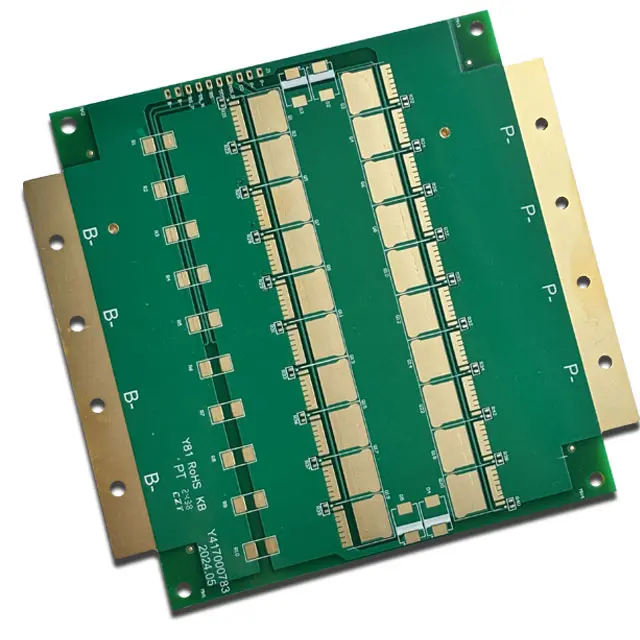
In the manufacturing of double-layer Printed Circuit Boards (PCBs), copper foil etching is a critical subtractive process that directly determines circuit pattern accuracy, uniformity, and reliability. Its core goal is to selectively remove excess copper foil from the substrate (typically FR-4) according to the designed circuit pattern, retaining the required copper conductors. For double-layer PCBs with different copper thicknesses—specifically 1oz inner layer and 2oz outer layer copper foil—etching process control becomes particularly challenging. Due to the significant thickness difference (1oz ≈ 35μm, 2oz ≈ 70μm), the two layers inherently differ in etching rate and uniformity. Improper process parameter design easily causes inconsistent side etching between inner and outer layers, leading to quality defects such as uneven circuit width, reduced conductor cross-sectional area, poor impedance matching, and even open or short circuits.
Among all etching parameters (etching solution concentration, temperature, spray pressure, flow rate, and spray angle), the spray angle is one of the most critical yet easily overlooked factors. It directly affects the contact state between the etching solution and copper foil, solution distribution uniformity, solution renewal rate on the copper suRFace, and shear force acting on etched cuprous chloride products. For double-layer copper foil with different thicknesses, a reasonable spray angle design can effectively compensate for etching rate differences caused by thickness variations, ensuring consistent side etching of inner (1oz) and outer (2oz) circuits, and improving overall PCB quality and yield.
This article focuses on the core question: How to design the etching solution spray angle to ensure consistent side etching of two-layer circuits when etching double-layer copper foil (inner layer 1oz, outer layer 2oz)? It systematically elaborates on relevant theoretical foundations, key influencing factors, specific design methods, optimization strategies for inconsistent side etching, and practical application cases, providing targeted technical guidance for PCB manufacturing engineers and process technicians.
1. Basic Principles of Double-Layer Copper Foil Etching and Side Etching
A clear understanding of copper foil etching principles, side etching formation mechanisms, and inherent differences in etching characteristics between inner 1oz and outer 2oz copper foil is the theoretical basis for spray angle design and process optimization.
1.1 Basic Principles of Copper Foil Etching
Wet chemical etching is the most commonly used method in PCB manufacturing. It uses acidic etching solutions (ammonium persulfate-based, ferric chloride-based, or cupric chloride-based) to chemically react with copper foil, dissolving excess copper into soluble copper salts to form circuit patterns. Among these, cupric chloride-based solutions are most widely used in double-layer PCB etching due to their high etching rate, good uniformity, low environmental pollution, and recyclability.
The chemical reaction mechanism of cupric chloride-based solutions with copper foil is as follows:
Primary etching reaction: Cu + CuCl₂ → 2CuCl (cuprous chloride, insoluble in water)
Secondary dissolution reaction: CuCl + 2HCl (excess) + H₂O₂ (oxidant) → 2CuCl₂ + 2H₂O
During etching, Cu²⁺ ions in the solution react with copper foil to form insoluble CuCl precipitates, which are then dissolved by excess HCl and H₂O₂ to regenerate CuCl₂, ensuring continuous and stable etching. The etching rate is mainly determined by Cu²⁺ concentration, HCl concentration, oxidant content, temperature, and the contact state between the solution and copper foil.
For double-layer PCBs, inner and outer copper foils are etched in the same spray-type etching machine, but their etching environments differ. The outer layer is directly exposed to the solution spray, while the inner layer, located between two substrates, requires the solution to penetrate via holes (0.3-0.8mm in diameter) or substrate gaps, resulting in lower contact efficiency and solution renewal rate for the inner layer.
1.2 Formation Mechanism of Side Etching
Side etching (undercutting) refers to the phenomenon where the etching solution etches copper foil both vertically (perpendicular to the substrate) and horizontally (parallel to the substrate) under the photoresist. This causes the etched circuit width to be smaller than the photoresist pattern width, with circuit sidewalls showing a certain slope. While inevitable in wet etching, excessive or inconsistent side etching seriously affects circuit accuracy.
Side etching is mainly caused by two factors: (1) Etching solution diffusion: The solution diffuses under the photoresist through gaps between the photoresist and copper foil, reacting with copper sidewalls. Diffusion rate is related to solution viscosity, temperature, and photoresist-copper contact pressure—higher temperature and lower viscosity increase diffusion and side etching. (2) Spray shear force: The sprayed solution exerts shear force on the copper surface, removing CuCl precipitates to promote solution renewal and vertical etching. Improper spray angle or excessive shear force enhances horizontal etching, while insufficient shear force leads to CuCl accumulation and uneven side etching.
The ideal side etching amount for double-layer PCBs is 5-10μm per side, with an inner-outer layer difference ≤ 3μm. Exceeding this difference causes inconsistent circuit widths, affecting impedance matching and signal transmission, especially for high-frequency and high-speed PCBs.
1.3 Etching Characteristic Differences Between Inner 1oz and Outer 2oz Copper Foil
The significant thickness difference between inner (35μm) and outer (70μm) copper foils leads to obvious differences in their etching characteristics, which is the core challenge for consistent side etching:
1. Etching time requirement: Etching time is proportional to copper thickness. Under the same conditions, the outer layer requires twice the etching time of the inner layer. Using outer-layer-based time causes inner-layer over-etching; using inner-layer-based time leaves outer-layer residual copper.
2. Etching rate: Thin 1oz copper foil has a stable etching rate due to small unit-volume contact area and easy heat dissipation. Thick 2oz copper foil has a faster initial rate (large contact area and heat accumulation) that decreases in the later etching stage, leading to uneven etching.
3. Spray contact state: The outer layer has high spray coverage, uniform shear force, and fast solution renewal. The inner layer has low coverage, uneven shear force, and slow renewal, resulting in a lower etching rate than the outer layer.
4. Side etching tendency: The thin inner layer has a fast vertical etching rate and controllable side etching (but is prone to over-etching). The thick outer layer has a long vertical etching time, more solution diffusion time, and stronger side etching tendency, exacerbated by uneven spray shear force.
These differences require a differentiated spray angle design rather than a "one-size-fits-all" approach to achieve consistent side etching.
2. Key Influencing Factors of Spray Angle Design
The spray angle is the angle between the central axis of the nozzle spray jet and the copper foil surface. For double-layer copper foil, its design is affected by multiple factors, which must be clarified to ensure rationality.
2.1 Nozzle Type and Structure
Nozzles determine spray angle, shape, and uniformity. Commonly used types include flat fan (15°-120° adjustable, uniform spray, most widely used), conical (30°-120°, concentrated central shear force, suitable for outer 2oz foil), and spiral (45°-180°, good atomization but low shear force, suitable for inner 1oz foil with low circuit density). Nozzle structure (spray hole number, diameter, flow channel design) also affects spray performance—multiple holes improve coverage, while small holes increase pressure and shear force.
2.2 Spray Pressure and Flow Rate
Spray pressure and flow rate are closely related to the spray angle—under the same nozzle conditions, the angle increases with pressure and flow rate until stability. The outer 2oz foil requires higher pressure (0.15-0.25MPa) and flow rate to ensure sufficient shear force, but excessive pressure causes uneven solution distribution and photoresist damage. The inner 1oz foil requires lower pressure (0.10-0.18MPa) to avoid copper/photoresist damage, but insufficient pressure leads to CuCl accumulation.
2.3 Copper Thickness and Circuit Density
Copper thickness is the core factor: inner 1oz foil (fast vertical etching, diffusion-dominated side etching) requires a smaller spray angle (30°-45°); outer 2oz foil (long vertical etching, diffusion and shear force-dominated side etching) requires a larger angle (45°-60°). Circuit density adjusts this range: high-density circuits (line width/line spacing ≤ 0.1mm) need smaller angles (inner 30°-35°, outer 45°-50°) to avoid short circuits; low-density circuits (≥ 0.2mm) allow larger angles (inner 40°-45°, outer 55°-60°) to improve efficiency.
2.4 Other Influencing Factors
Substrate structure: More/larger via holes (≥ 100/cm², ≥ 0.5mm) improve inner-layer solution penetration, allowing a slightly larger inner angle (35°-45°); fewer/smaller via holes require a smaller inner angle (30°-35°). Etching solution characteristics: Low viscosity/surface tension allows smaller angles; high viscosity requires larger angles. Equipment structure: Spray distance (50-100mm)—larger distance for inner layers (80-100mm) reduces shear force, smaller distance for outer layers (50-80mm) increases shear force. Staggered nozzle arrangement (10%-20% overlap) avoids spray blind areas.
3. Specific Spray Angle Design Method
The design method includes four practical steps to ensure consistent side etching:
3.1 Pre-Design Preparation
Collect key parameters (copper thickness, circuit density, substrate/via hole parameters, photoresist type, etching solution parameters, nozzle type, spray pressure/distance). Determine design goals (side etching 5-10μm, inner-outer difference ≤ 3μm, uniformity ≥ 90%, yield ≥ 98%). Prepare experimental equipment (spray-type etching machine), samples (double-layer PCBs with standard test patterns), and measuring tools (1μm accuracy metallographic microscope, line width measuring instrument).
3.2 Initial Spray Angle Determination
1. Determine the basic range based on copper thickness: inner 30°-45°, outer 45°-60°. 2. Adjust based on circuit density: high-density (lower limit), medium-density (middle, 0.1-0.2mm: inner 35°-40°, outer 50°-55°), low-density (upper limit). 3. Adjust based on nozzle type and pressure: conical outer nozzles reduce angle by 5°-10°; spiral inner nozzles increase by 5°-10°; higher outer pressure reduces angle by 5°; lower inner pressure increases by 5°. 4. Determine upper (outer layer) and lower (inner layer) nozzle angles symmetrically.
Example: Medium-density (0.15mm) double-layer PCB, flat fan nozzles, inner pressure 0.15MPa, outer pressure 0.20MPa, spray distance 70mm—initial angles: inner 38°, outer 52°.
3.3 Spray Angle Optimization
Adopt single-factor experiments: keep other parameters unchanged, adjust inner (36°-40°) or outer (50°-54°) angles at 1° intervals, prepare 5 samples per level. After etching, measure side etching at 10 points per sample, calculate average and maximum deviation. Analyze data to find the optimal angle combination (meets design goals, highest efficiency). Conduct interactive optimization (±1° adjustment of optimal angles) to confirm stability.
Example: Optimizing initial angles (38° inner, 52° outer) shows the optimal combination is 38° inner and 51° outer (inner side etching 7.2μm, outer 7.8μm, difference 0.6μm, maximum deviation 1.8μm).
3.4 Verification and Confirmation
Conduct batch verification with 100 samples, using the optimal angle. Sample 10% (10 samples) to inspect side etching, uniformity, circuit quality, and via hole quality. If indicators meet requirements (yield ≥ 98%), document parameters in the process specification and train operators. If not, adjust parameters (nozzle cleaning, pressure calibration) and re-verify.
4. Optimization Strategies for Inconsistent Side Etching
Targeted strategies address common inconsistencies in actual production:
4.1 Inner Layer Side Etching > Outer Layer
Reasons: Excessive inner spray angle/pressure, long etching time, fast solution diffusion. Solutions: Reduce inner angle by 2°-3°, reduce inner pressure by 0.02-0.03MPa, shorten etching time by 5%-10% (ensure no outer residual copper), optimize inner photoresist (increase thickness by 10%-15%), and reduce inner solution circulation speed.
4.2 Outer Layer Side Etching > Inner Layer
Reasons: Excessive outer spray angle/pressure, long etching time, photoresist damage, high temperature. Solutions: Reduce outer angle by 2°-3°, reduce outer pressure by 0.02-0.03MPa (increase flow rate if residual copper exists), control temperature at 40-45℃, clean/replace worn outer nozzles (service life 3-6 months), and adopt two-stage etching (pre-etching + main etching) for the outer layer.
4.3 Uneven Side Etching Within the Same Layer
Reasons: Uneven spray distribution, nozzle blockage, uneven copper/photoresist thickness, insufficient solution stirring. Solutions: Adjust nozzle arrangement (10%-20% overlap), calibrate spray pressure/flow rate, control copper thickness fluctuation ≤ 3μm, optimize photoresist coating (thickness uniformity ≤ 2μm), and improve solution stirring.
5. Practical Application Case
A PCB enterprise producing automotive electronics double-layer PCBs (inner 1oz, outer 2oz, medium density 0.15mm, cupric chloride solution) faced inner-outer side etching differences of 5-8μm and a 92% yield. Adopting the proposed design method:
1. Pre-preparation: Set goals (side etching 5-10μm, difference ≤ 3μm, yield ≥ 98%), select flat fan nozzles, spray distance 70mm, inner pressure 0.15MPa, outer pressure 0.20MPa, temperature 42℃. 2. Initial angles: 38° inner, 52° outer. 3. Optimization: Final optimal angles 38° inner, 51°. 4. Batch verification: 100 samples, average side etching 7.0-7.5μm (inner) and 7.5-8.0μm (outer), difference 0.3-0.8μm, yield 98.5%. Continuous 3-month production confirmed stability, resolving customer complaints.
Designing the etching solution spray angle for double-layer copper foil (inner 1oz, outer 2oz) requires full consideration of etching principles, side etching mechanisms, and key influencing factors (nozzle type, pressure, copper thickness, etc.). The four-step design method (preparation, initial angle determination, optimization, verification) effectively ensures consistent side etching. Targeted optimization strategies address production inconsistencies, while practical cases verify the method’s feasibility. This approach improves PCB circuit precision and yield, providing valuable technical support for PCB manufacturing.