Before the test, it is necessary to ensure that the MSD is dry (baked at 125℃ for 24 hours). The specific soaking conditions are shown in Table 2:
Table 2. MSL Classification Test Soaking (SOAK) Time
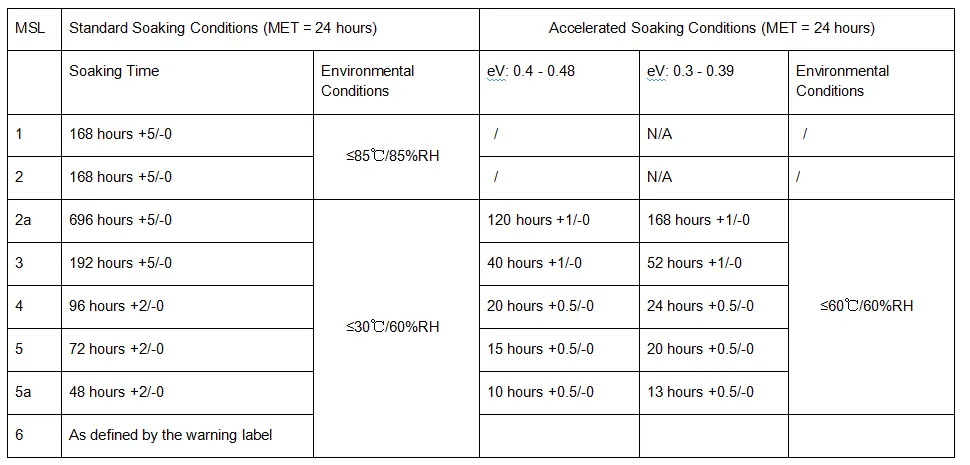
The above test by default includes the maximum exposure time (MET = 24 hours) for the supplier's baked packaging/distributor's unpacking. If MET ≠ 24 hours, the corresponding soaking time can be increased or decreased accordingly (standard conditions: MET ± 1 hour corresponds to soaking time ± 1 hour; accelerated conditions: MET ± 5 hours corresponds to soaking time ± 1 hour).
The activation energy in eV indicates the moisture diffusion ability of different encapsulation materials and represents the equivalent factor between accelerated and standard conditions. There may be potential stress damage risks to the device during the test after soaking under activation energy conditions. Therefore, the eV conditions need to be clarified before the test. If the activation energy of moisture diffusion of the material is not included in the above table, the JESD22 - A120 standard can be referred to for clarification.
SMDs with thinner encapsulation and smaller volume have higher requirements for reflow soldering temperature during MSL classification. According to different SMD encapsulation structures and single - board reflow soldering assembly processes, the requirements for peak reflow soldering temperature are shown in Table 3 below:
Table 3. MSL Classification Peak Reflow Soldering Temperature
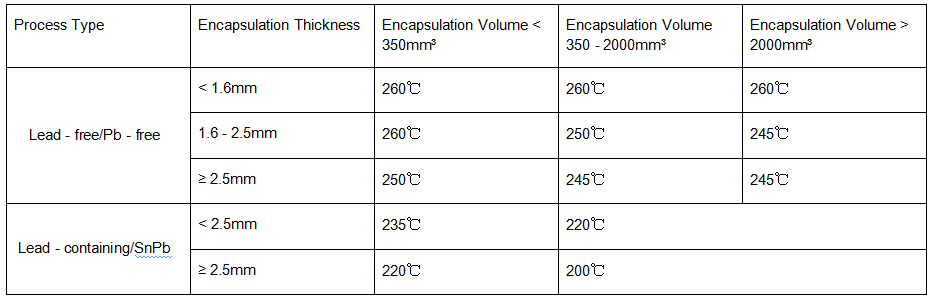
Note: 2.4.1 The above encapsulation volume does not include the volume occupied by the device's external leads (or terminals/bump balls, etc.) and embedded heat sinks.

 PCB
PCB FPC
FPC Rigid-Flex
 FR-4
FR-4 HDI PCB
 Rogers High-Frequency Board
 PTFE Teflon High-Frequency Board
 Aluminum
 Copper Core
 PCB Assembly
 LED light PCBA
 Memory PCBA
 Power Supply PCBA
 New Energey PCBA
 Communication PCBA
 Industrial Control PCBA
 Medical Equipment PCBA
 Testing Service
 PCBA Testing Service
 Certification Application
 RoHS Certification Application
 REACH Certification Application
 CE Certification Application
 FCC Certification Application
 CQC Certification Application
 UL Certification Application
 Transformers, Inductors
 High Frequency Transformers
 Low Frequency Transformers
 High Power Transformers
 Conversion Transformers
 Sealed Transformers
 Ring Transformers
 Inductors
 Wires,Cables Customized
 Network Cables
 Power Cords
 Antenna Cables
 Coaxial Cables
 Net Position Indicator
 Solar AIS net position indicator
 Capacitors
 Connectors
 Diodes
 Embedded Processors & Controllers
 Digital Signal Processors (DSP/DSC)
 Microcontrollers (MCU/MPU/SOC)
 Programmable Logic Device(CPLD/FPGA)
 Communication Modules/IoT
 Resistors
 Through Hole Resistors
 Resistor Networks, Arrays
 Potentiometers,Variable Resistors
 Aluminum Case,Porcelain Tube Resistance
 Current Sense Resistors,Shunt Resistors
 Switches
 Transistors
 Power Modules
 Isolated Power Modules
 AC-DC Power Modules
 DC-AC Module(Inverter)
 RF and Wireless